
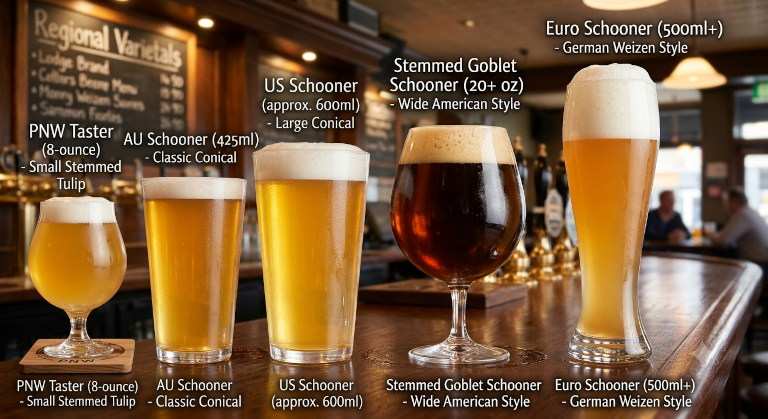
What is a schooner of beer?
A beer schooner varies by region. In Australia, it is a standard glass size holding 425 ml (about 15 oz). In the UK, it refers to a 2/3 pint (380 ml) measure. In North America, it refers to a large goblet or tankard-style glass holding anywhere from 18 to 32 oz.
The definition of a schooner strongly depends on the region where you are ordering your drink:
- Australia: It is the standard middle-ground serving size, smaller than an imperial pint (568 ml) but larger than a pot or middy (285 ml). According to Reddit, regional names differ widely (e.g., in South Australia, a 'schooner' is actually the size of a pint, while what is elsewhere called a schooner is called a 'pot').
- North America: The term "schooner" typically refers to the shape of the glassware rather than a specific volume. These are often thick, short-stemmed glasses or oversized tankard mugs holding 18 to 32 fluid ounces. They are frequently used for wheat beers, micheladas, or large-format lagers.
- United Kingdom: A schooner was introduced as a legal measurement equivalent to 2/3 of a pint. It is most commonly found in craft beer pubs because it allows drinkers to enjoy stronger, higher-ABV beers in a moderate portion.
- In the Pacific Northwest, a "schooner" flips the standard American rule, referring to a smaller-than-average beer pour, typically holding 8 to 12 fluid ounces.
I grew up in the Pacific Northwest, where a schooner was a humble 8-ounce pour—just enough to make you feel like a responsible adult. So imagine my shock when, elsewhere, my "schooner" arrived as a 32-ounce, two-handed goblet fit for a Viking feast. Suddenly, my quick drink turned into a marathon session, and I was left cradling my glass like a newborn, pondering regional beer mysteries and the meaning of moderation. Cheers to cultural confusion!
