
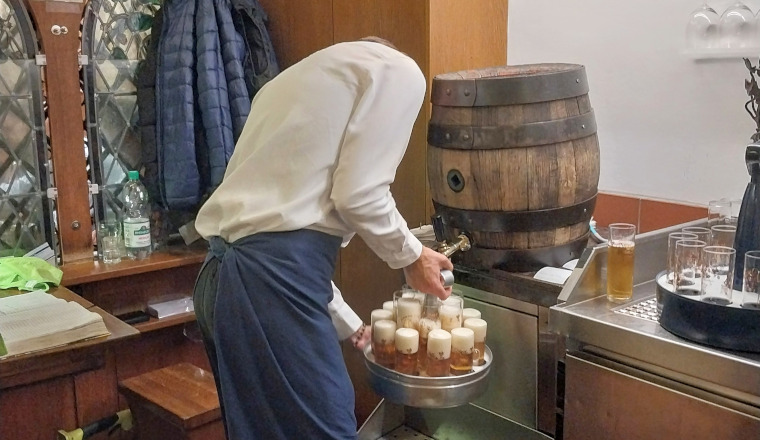
Last year, my wife and I set off on a river journey across Europe, drifting from Budapest to Amsterdam. For me, it was more than a trip—it was a pilgrimage through the heartlands of my favorite beers. I made it my mission to visit as many Beer Halls as possible, and in Bamberg and Cologne, I struck gold: both still poured beer straight from the cask. Until then, I had only glimpsed this ritual on TV segments about Oktoberfest, never in person. Watching the cask being tapped was a spectacle in itself, and the beer tasted extraordinary. There’s a certain magic in how this tradition transforms the brew.
Still, cask ale wasn’t entirely foreign to me. Back in Seattle, one of my favorite local spots often featured cask ales, served the old-fashioned way with a traditional beer engine. They too were very enjoyable and easy to consume. Now I need to convince my wife to take a trip to the U.K. to experience it there.
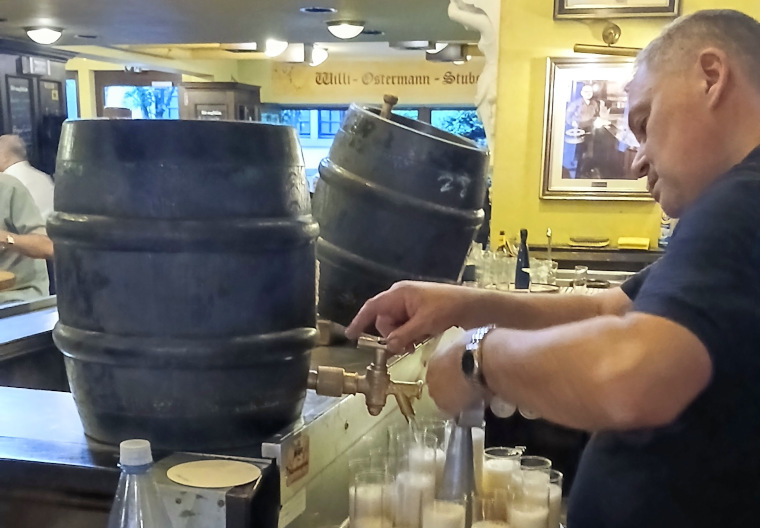
Bavarian Cask (Bayerischer Anstich)
In Germany, pouring from a traditional wooden cask is often referred to as a Bayerischer Anstich (Bavarian tapping).
When people think of beers aged in wooden barrels today, they usually think of Bourbon barrel-aged stouts or sour ales that absorb heavy oak, vanilla, or whiskey flavors from the wood. German cask beer is different.
Traditional German brewers line the inside of their oak barrels with pitch (Pech), a natural resin made from pine sap. This pitch lining creates a watertight seal between the beer and the wood, so the beer never actually touches the oak. That helps preserve the crisp, clean flavor of the Pilsner or Helles, and barrels have to be re-pitched regularly by skilled craftsmen.
Tapping a German cask is an event. Instead of hooking the barrel up to a modern gas line or a hand pump, the bartender or a local dignitary uses a large wooden mallet (Schlegel) to hammer a brass tap (Hirsch) directly into the barrel.
If you’ve ever watched the opening ceremonies of Oktoberfest in Munich, this is exactly what the Mayor does when he hammers the tap into the first barrel and yells, “O’zapft is!” (“It is tapped!”).
In regions like Franconia (northern Bavaria), there is a specific style of cask beer called Ungespundetes (or “U” for short). During fermentation, the brewer leaves the bung (the stopper at the top of the cask) slightly open or removes it entirely.
This allows the natural CO2 created by the yeast to escape rather than building up pressure. The resulting beer has very little carbonation, pours with a light head, and feels smooth and creamy. It goes down so easily that locals consider it the ultimate thirst-quencher.
The beers most traditionally served from these casks in Germany are known as Kellerbier (“cellar beer”) or Zwickelbier. Because the yeast is still suspended in the beer, it looks slightly cloudy and has a richer, breadier malt profile and a spicier hop bite than its heavily filtered counterpart.
Today, modern stainless-steel kegs have largely taken over, making the Holzfass a rare treat reserved for special occasions. Even so, there are holdouts! The Augustiner Brewery in Munich is famous for still using massive traditional wooden casks for all of its beer served at the Munich Oktoberfest, refusing to switch to steel kegs for the festival. Additionally, if you visit the rural beer gardens (called Kellers) in the forests around Bamberg, Germany, you can still find brewers serving everyday lagers straight from gravity casks.
Experiencing this firsthand is one of the world’s most unforgettable beer traditions.
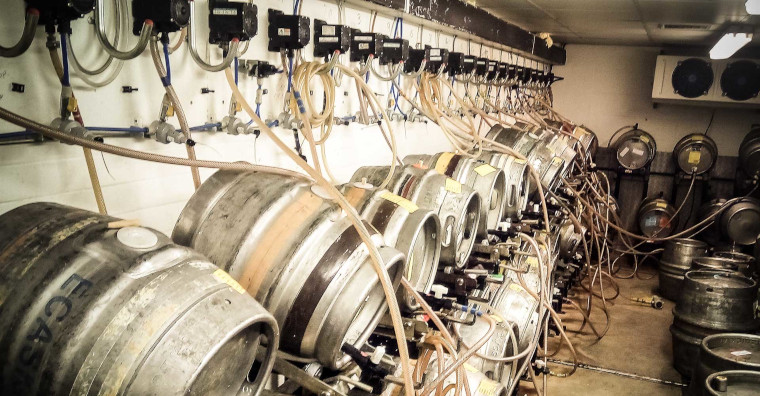
Cask Ale
Cask ale, often referred to as "Real Ale" by organizations like CAMRA (Campaign for Real Ale) in the UK, is a traditional art form. The way it is conditioned and served creates a different drinking experience compared to standard keg beer.
Standard draft beer is carbonated under pressure with CO2 or nitrogen, which can make it aggressively fizzy and sometimes harsh on the palate. Cask ale, on the other hand, undergoes a secondary fermentation right inside the barrel. As a result, this produces gentle, natural carbonation and a smooth, velvety texture that glides across your tongue rather than biting it with bubbles.
Cask beer is typically stored and served at cellar temperature (around 50°F to 55°F), whereas keg beer is usually served much colder (often below 40°F). Extreme cold numbs your taste buds and traps aromatic compounds. Serving the beer slightly warmer allows the nuanced flavors of the malt and hops to bloom, making the flavor profile more robust.
Because cask ale is unfiltered and unpasteurized, it is a "living" product. The yeast remains active in the cask, continually maturing the beer's flavor profile right up until the moment it is pulled through a traditional hand-pump (a beer engine) or poured by gravity. This ongoing evolution adds depth, richness, and vibrancy you just can't get from a pasteurized keg.
Brewers often add special ingredients—such as extra fresh hops (dry hopping) or primings (sugars)—directly into the cask before it leaves the brewery. This direct contact during conditioning gives the beer a fresh aroma.
Because they lack the harsh carbonation and freezing temperatures found in a standard chilled pint, many people describe cask ales as having a more complex flavor—often revealing toasty, biscuity, fruity, or floral notes that would otherwise be hidden.
Cask Ale vs. Lager
While both countries utilize traditional casks, the resulting beers and the culture surrounding them are completely different. If you compare a British cask ale (often called "Real Ale") to a German cask beer (often poured from a wooden barrel or Holzfass), here are the main differences you will notice:
1. The Style of Beer: Ale vs. Lager
- In the UK, British cask beer is almost exclusively ale (top-fermented). You will find styles like Bitters, Milds, Pale Ales, and Golden Ales. The ale yeast produces fruity, complex, and sometimes earthy or floral ester flavors.
- Germany: German cask beer is predominantly lager (bottom-fermented)—think Helles, Pilsner, Kellerbier, or Dunkel. Lagers use a different yeast that ferments at colder temperatures, producing a much crisper, cleaner, and bready flavor profile without the fruity esters found in British ales.
2. How It Is Poured (The Dispense Method)
- The UK: British casks are typically stored out of sight in a cool cellar below the pub. The bartender uses a tall hand-pump on the bar, called a "beer engine," to draw the beer up from the cellar by suction. In some parts of the UK, they use a "sparkler" on the nozzle to force a thick, creamy head.
- Germany: German cask beer is usually a spectacle. A large, traditional wooden barrel (Holzfass) is often hoisted right onto the bar counter. The bartender drives a tap directly into the barrel with a wooden mallet and pours the beer by gravity alone. There are no suction pumps involved.
3. Serving Temperature
- The UK: British cask ale is famously served at "cellar temperature," which is around 50°F to 55°F (11°C–13°C). Because it's not freezing cold, the delicate, nuanced flavors of the malt and hops can blossom.
- Germany: Because they are lagers, German cask beers are traditionally served colder than British ales. Even when poured from a wooden barrel, they keep the refreshing, crisp bite you expect from a German Pilsner or Helles.
4. Ingredients and Purity
- The UK: British brewers historically had more freedom to experiment with brewing sugars, finings to clear the beer, and direct additions of dry hops right into the cask.
- Germany: German brewers strictly follow the Reinheitsgebot (the German Beer Purity Law of 1516), which stipulates that beer may be made only with water, malt, hops, and yeast. This strict regulation ensures a very clean, traditional, and uniform profile across their cask lagers.
In short, a British cask ale is designed to be a smooth, complex drink that you can sit with for hours in a cozy pub, while a German cask beer gives you the incredibly fresh, crisp, and clean refreshment of a world-class lager poured straight from the wood!
